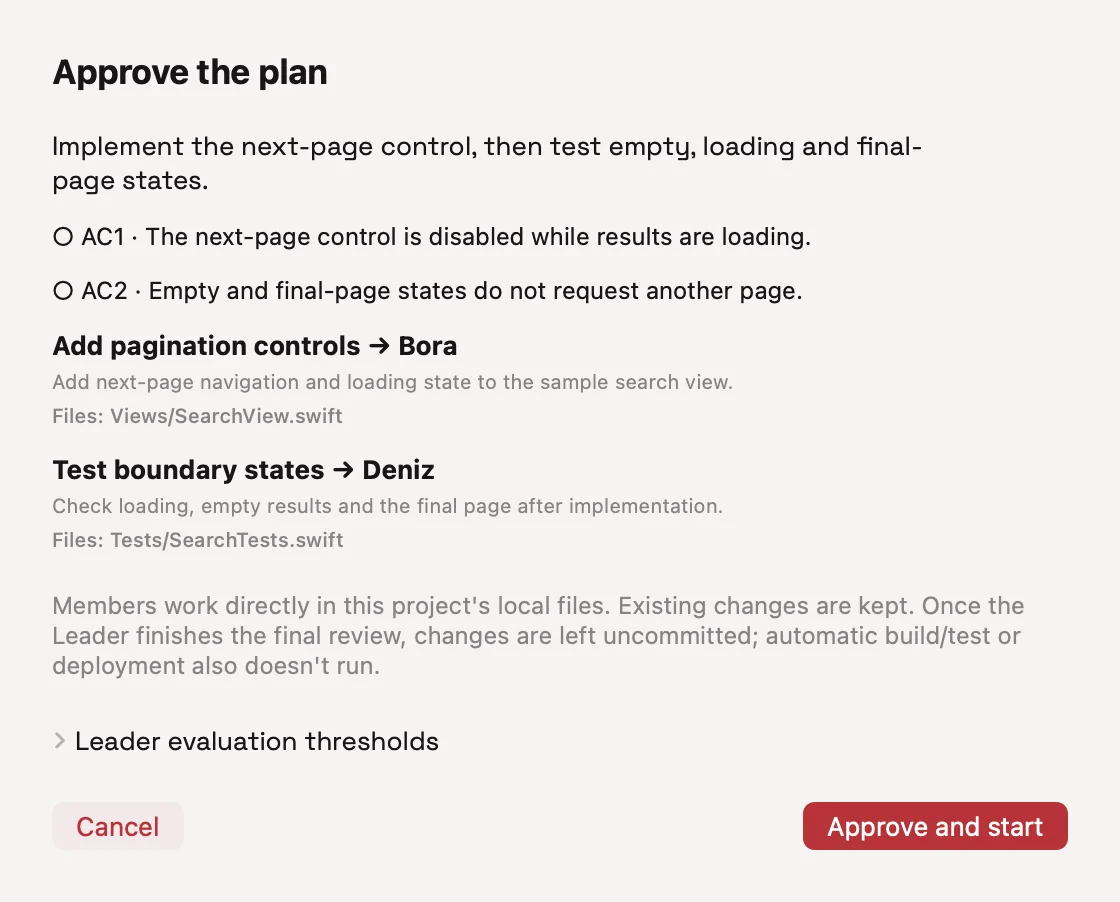
Choose how to combine the tools
For a second opinion on one task, running the two CLIs sequentially may be enough. OpenAI also provides a Claude Code plugin for Codex reviews or task delegation. For persistent teams, shared task tracking and approval visibility, Arenor lets you assign different providers to different members.
This guide does not assume one model is better than another. Choose roles around the task and your account access. Switching tools within a plan is not a controlled quality comparison.
Define one result
Our example is deliberately small: change “Save” to “Save changes”, explain the label in a readme and finish with a passing check. It uses no customer code, database, production deployment or account changes.
Goal: Change the button label to “Save changes”.
Acceptance criteria:
- button.txt contains exactly label=Save changes.
- README.md explains the new label.
- python3 check.py passes.
- Unrelated files are unchanged.Map roles to files and dependencies
The first two tasks can proceed independently because they write different files. Make final verification depend on both, so the reviewer does not test old code. A report saying “done” is not evidence that the test ran; ask for the command and its result.
| Role | Scope | Dependency |
|---|---|---|
| Developer · Claude Code | Update the label in button.txt | None |
| Documentation · Codex | Explain the label in README.md | The label is fixed in the brief |
| Test / Reviewer | Run check.py and inspect the diff | Both writing tasks must finish |
Choose the working directory
Arenor works in the attached project folder by default. With Git isolation enabled, a run gets a separate worktree shared by its members. That is different from giving every member a separate branch.
The worktree starts at HEAD, so uncommitted changes in the main folder are absent. If creation fails, the app can warn and continue in the main folder. Check the actual path and status messages before work starts.
- Sequence tasks that write the same file, or change file ownership.
- Treat shared build caches and output folders as shared resources too.
- Avoid changing the repository branch, HEAD or staging state externally during a run; Arenor may stop work when it detects the change.
Ask for evidence before accepting the result
The final report should name changed files, the command executed, its result and remaining limitations. A reviewer can inspect defects and missing tests without editing code. A second opinion, from the same or another provider, still needs verification.
git diff --check
git diff -- button.txt README.md
python3 check.pyWhat was tested here?
On October 2, 2026, a fresh temporary repository with Git 2.54.0 was used to verify working-directory isolation, a change diff, the sample Python check and transfer to a review worktree. The main folder kept its original label; the updated worktree passed the check.
This was not a Claude Code versus Codex benchmark or a live two-provider agent run. No paid model calls were made. Run the brief against your own small example and verify the generated result.
Make the final decision explicitly
Review an isolated run and apply the appropriate files to the main folder. Do not treat flagged conflicts as automatically resolved. Arenor can offer commit or commit-and-push for eligible completed runs; that is a separate user choice.
Undo is not guaranteed for every file or external system. Missing baselines and later manual edits limit what can be restored. Keep your own version-control and backup practices.
Questions
Are two agents always faster?
No. Work that edits the same files or depends on another task may gain little from parallelism. Choose narrow independent tasks and measure actual completion time.
Can I combine the tools without Arenor?
Yes. You can run the CLIs sequentially or use suitable official plugin/app workflows. Arenor adds shared team, task, approval and history management.